Estimated reading time: 28 minutes
The USPTO offers several programs that can speed up examination, improve communication with examiners, reduce unnecessary reopening of prosecution, or provide special handling for certain applicants and technologies. These programs are not all the same. Some provide true “special status” and move an application ahead of other applications. Others do not formally accelerate examination but can still shorten prosecution by improving communication, resolving procedural issues, or avoiding unnecessary Requests for Continued Examination (RCEs). The USPTO’s own Patent Initiatives page explains that these initiatives are intended to reduce backlogs, improve examination quality, support applicants, and accelerate the path to intellectual property protection.
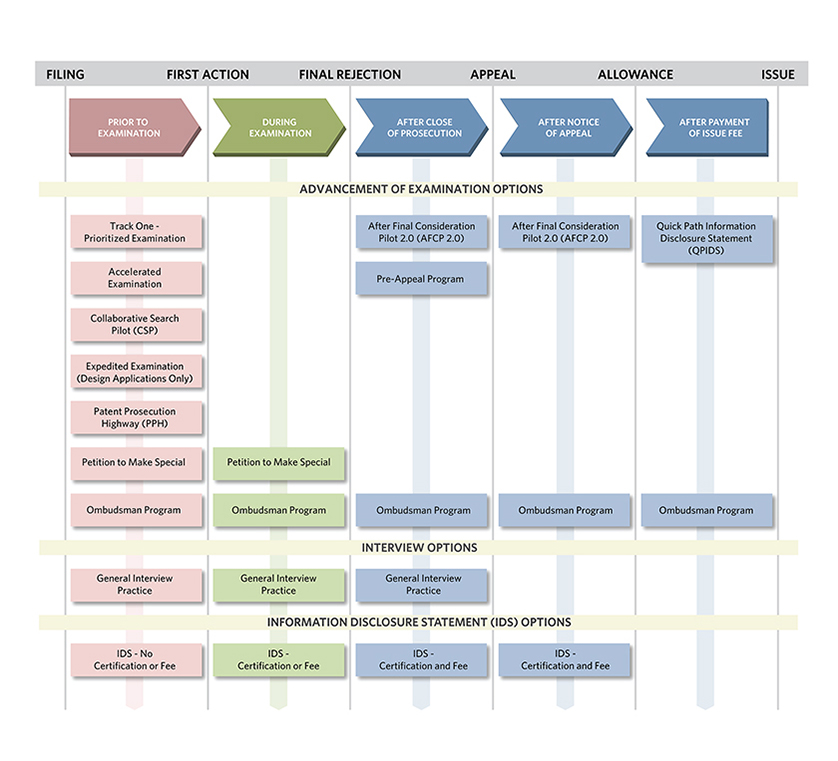
This guide organizes the currently available USPTO pilot programs, fast-track programs, and related patent prosecution initiatives by stage of prosecution: before examination, during examination, after final rejection or close of prosecution, and appeal/post-prosecution. It also flags several recently discontinued programs so applicants do not mistakenly rely on options that are no longer available. The USPTO’s Patent Application Initiatives Timeline is a useful starting point because it maps programs to different phases of the patent application process.
Important note on fees: USPTO fees change over time. The fee amounts discussed below are based on the USPTO fee schedule effective January 19, 2025, last revised July 1, 2026. Applicants should always verify the current amounts against the official USPTO fee schedule before filing.
Quick Comparison of Active USPTO Programs by Prosecution Stage
| Prosecution Stage | Program | Currently Available? | Provides Special Status / Acceleration? | Typical Use Case |
| Prior to examination | Track One Prioritized Examination | Yes | Yes, until final disposition | Applicants who want a final disposition in about 12 months |
| Prior to examination | Patent Prosecution Highway (PPH) | Yes | Yes, based on allowable claims from another participating IP office | Applicants with related foreign or international claims already found allowable |
| Prior to examination | Accelerated Examination for Design Applications | Yes | Yes | Design applicants needing faster disposition |
| Prior to examination | Streamlined Claim Set Pilot Program | Yes, pilot | Yes, until first Office action | Applicants with previously filed, unexamined utility applications and very limited claim sets |
| Prior to examination / appeal | SPARK Pilot Program | Yes, pilot | Yes, until first Office action or for ex parte appeal | Qualifying U.S.-domiciled small/medium businesses, universities, and nonprofits involved in standards development |
| During examination | Petition to Make Special | Yes | Yes, if granted | Applicants qualifying under specific grounds for special status |
| During examination | Patents Ombuds Program | Yes | No formal acceleration | Applicants facing procedural, communication, or prosecution roadblocks |
| During / after close | General Interview Practice | Yes | No formal acceleration, but can shorten prosecution | Applicants who want to clarify issues directly with the examiner |
| After close of prosecution | Pre-Appeal Brief Conference Program | Yes, pilot | No special status, but may avoid full appeal | Applicants who believe final rejections are clearly improper |
| After allowance / issue-fee payment | QPIDS | Yes, permanent | No formal acceleration, but may avoid RCE delay | Applicants needing to submit an IDS after payment of the issue fee |
| Appeal stage | PTAB Ex Parte Appeal | Yes | Not a fast-track program by default | Applicants challenging an examiner’s adverse decision after claims have been twice rejected |
| Appeal stage | SPARK expedited appeal | Yes, pilot | Yes, for qualifying ex parte appeals | Qualifying standards-participating entities seeking faster PTAB handling |
I. Programs Available Prior to Examination
1. Track One Prioritized Examination
Track One is the USPTO’s best-known paid fast-track program for utility and plant patent applications. The USPTO describes Track One as a way to obtain prioritized examination with a goal of reaching final disposition within about twelve months after prioritized status is granted.
Track One is available for original utility and plant applications, and a single request for prioritized examination may also be granted with an RCE in a utility or plant application. The program is not intended for design applications; design applicants instead look to accelerated examination for design applications.
Track One gives an application special status, meaning it is taken up ahead of ordinary applications. According to the USPTO’s prior-to-examination initiatives matrix, Track One remains in special status until final disposition. The USPTO increased the annual limit for accepted Track One requests from 15,000 to 20,000 effective July 8, 2025.
Key Eligibility Requirements
Track One applications are limited to no more than four independent claims and no more than thirty total claims. Multiple dependent claims are not permitted under Track One. The applicant does not need to conduct a pre-examination search or file an examination support document, which is one of the major practical advantages of Track One over older accelerated examination practice.
Track One is generally most useful when the application is ready for examination and the applicant can respond quickly. The USPTO’s initiatives matrix notes that shortened response timing applies and that filing an extension of time removes the application from Track One.
USPTO Fees
Track One requires the Track One prioritized examination fee, the processing fee, and the publication fee, in addition to the ordinary filing, search, and examination fees for a new application. The USPTO fee schedule identifies the current fee schedule as effective January 19, 2025, last revised July 1, 2026.
As of the current fee materials, the Track One prioritized examination fee is $4,000 for a large entity, $2,000 for a small entity, and $1,000 for a micro entity. The Track One processing fee under 37 C.F.R. § 1.17(i)(1) is $140 for a large entity, $70 for a small entity, and $35 for a micro entity. Applicants should also confirm the current publication fee and ordinary application filing/search/examination fees before filing.
Pros
Track One is often the most straightforward way to buy speed at the USPTO. The program does not require a pre-examination search or examination support document, and it is available for a broad range of utility and plant applications. It is particularly helpful for startups seeking investor confidence, companies preparing for product launch, applicants facing possible infringement, and foreign applicants who want a U.S. patent family member examined quickly.
Cons
Track One can also be strategically valuable when a client needs an early indication of patentability. Even if the first Office action is not an allowance, it gives the applicant examiner feedback much earlier than the ordinary queue.
Track One is relatively expensive compared with ordinary examination. It also requires disciplined prosecution because extensions of time can knock the application out of prioritized status. The claim limits may also be too restrictive for complex inventions that need multiple independent claim categories or broader fallback coverage.
Best Fit
Track One is best for commercially important utility or plant applications where speed is worth the extra cost. It is usually most attractive for core technology, fundraising-sensitive applications, licensing targets, competitive product launches, and applications where the applicant can live with a focused claim set.
USPTO program link: Track One Prioritized Examination.
2. Patent Prosecution Highway (PPH)
The Patent Prosecution Highway allows an applicant to request fast-track examination in a later patent office when a participating earlier office has found at least one corresponding claim allowable or patentable. The PPH is an international worksharing program designed to help applicants obtain faster protection across jurisdictions by leveraging work already performed by another intellectual property office.
At the USPTO, the PPH is available when the application has corresponding claims sufficiently related to claims that another participating office has found allowable. The USPTO explains that PPH applications represent about 2% of filings and historically had average first-action pendency around 7.5 months. The USPTO has also implemented an updated docketing approach so that PPH first-action pendency in a given technology area is approximately half the time of non-PPH applications.
Key Eligibility Requirements
The applicant generally needs a positive patentability ruling from a participating Office of Earlier Examination and corresponding claims in the USPTO application. The USPTO’s initiatives matrix distinguishes between Global/IP5 PPH and bilateral PPH arrangements, and applicants should check the PPH page for current participating offices and agreement-specific rules.
For Global/IP5 PPH, the USPTO matrix states that continuing applications such as continuations and divisionals may be eligible before a first Office action, but RCEs are not eligible under that category.
USPTO Fees
The USPTO’s prior-to-examination initiatives matrix identifies no surcharge or fee for PPH. This makes PPH one of the most cost-effective acceleration options when the applicant already has allowable claims from a participating foreign or international office.
Pros
The biggest advantage of PPH is that it can accelerate examination without a USPTO petition fee. It is especially useful for applicants with international patent portfolios, including applicants who have already received favorable treatment in Japan, Europe, Korea, China, Canada, Australia, or through PCT work products, depending on the applicable PPH arrangement.
PPH can also improve prosecution efficiency because the USPTO examiner receives the benefit of work already performed by another office.
Cons
PPH is not available unless there is a qualifying positive work product from another participating office. The U.S. claims must also correspond to the allowable foreign or international claims, which may limit the applicant’s ability to pursue broader or differently framed U.S. claims. In addition, the USPTO’s updated docketing practice means PPH remains faster than ordinary examination, but the acceleration is now calibrated relative to non-PPH pendency in the relevant technology area.
Best Fit
PPH is best for applicants with active foreign filing strategies and at least one favorable foreign or PCT examination result. It is particularly useful for foreign applicants entering the United States, U.S. applicants with parallel foreign cases, and cost-sensitive applicants who want acceleration without paying Track One fees.
USPTO program link: Patent Prosecution Highway (PPH).
3. Accelerated Examination for Design Applications
Accelerated Examination is now a design-focused program. The USPTO expressly states that it will not accept petitions under the Accelerated Examination program filed on or after July 10, 2025, in utility applications, but the program remains in effect for design applications.
For design applications, accelerated examination provides an opportunity to reach final disposition in twelve months. The USPTO’s prior-to-examination matrix identifies the design accelerated examination program as active, permanent, and available with a petition.
Key Eligibility Requirements
Design accelerated examination requires a petition and an examination support document. The USPTO matrix also indicates that an interview is required unless the claims are in condition for allowance. For design applications, response timing is shortened, including a non-extendable one-month response time until final rejection or allowance.
USPTO Fees
The USPTO’s prior-to-examination matrix states that accelerated examination for design applications requires the petition fee set forth in 37 C.F.R. § 1.17(h). The current fee materials identify the request for expedited examination of a design application under 37 C.F.R. § 1.17(k) as $900 for a large entity, $450 for a small entity, and $225 for a micro entity. Applicants should verify the exact fee code and current fee amount against the USPTO fee schedule before filing.
Pros
This program can be useful when design protection is time-sensitive, such as consumer products, user interface designs, packaging, fashion-adjacent products, and products likely to be copied quickly. The goal of final disposition in twelve months can be commercially valuable for products with short market windows.
Cons
The program is procedurally more burdensome than Track One because it requires an examination support document and may require more pre-filing work. The shortened, non-extendable response periods can also be unforgiving. Utility applicants should not rely on this program because utility accelerated examination is no longer available for petitions filed on or after July 10, 2025.
Best Fit
This program is best for design patent applicants who need fast protection for a commercially important product appearance and are prepared to do the required pre-filing search and support work.
USPTO program link: Accelerated Examination for Design Applications.
4. Streamlined Claim Set Pilot Program
The Streamlined Claim Set Pilot Program is a newer USPTO pilot designed to evaluate how limited claim sets affect pendency and examination quality. The USPTO began accepting petitions on October 27, 2025, for certain previously filed, unexamined utility patent applications that satisfy the program’s claim requirements.
Applications accepted into the program are advanced out of turn and granted special status until a first Office action is issued. The USPTO will accept petitions until October 27, 2026, or until each Technology Center examining utility applications has docketed approximately 200 accepted applications, whichever occurs first.
Key Eligibility Requirements
The application must be a noncontinuing, original, non-reissue utility nonprovisional application filed under 35 U.S.C. § 111(a) before October 27, 2025. Applications claiming benefit of prior nonprovisional U.S. applications or international applications designating the United States are not eligible, and national stage applications are also not eligible.
The application must have been filed electronically using Patent Center, and the specification, claims, and abstract must have complied with USPTO DOCX requirements at the time of filing. The application must contain no more than one independent claim, no more than ten total claims, no multiple dependent claims, and dependent claims must follow the dependency format described in the program requirements.
The USPTO warns that applicants should not file a petition if the application is already docketed to an examiner, because the petition will generally be dismissed if the application has already been docketed to a particular examiner when the petition is taken up for decision.
USPTO Fees
The USPTO initially required a petition fee, but it has waived the petition fee under 37 C.F.R. § 1.17(h) for petitions filed on or after June 10, 2026, using form PTO/SB/472.
Pros
This pilot can be an attractive no-fee acceleration option for qualifying applications. It is especially useful where the applicant already has a very focused claim strategy or is willing to narrow the claim set to accelerate the first Office action.
Because the program advances the application until the first Office action, it can help applicants obtain examiner feedback sooner without paying Track One fees.
Cons
The eligibility requirements are narrow. The application must be previously filed, unexamined, electronically filed in Patent Center, DOCX-compliant at filing, and limited to one independent claim and ten total claims. Continuing applications, national stage applications, and applications already docketed to an examiner are not good candidates.
The acceleration also lasts only until the first Office action, not through final disposition. That makes it less powerful than Track One for applicants who want the entire case driven to final disposition quickly.
Best Fit
This pilot is best for applicants with unexamined, original utility applications that already have or can tolerate a compact claim set. It may be especially useful for cost-sensitive startups, individual inventors, and small entities who want earlier examination but do not want to pay Track One fees.
USPTO program link: Streamlined Claim Set Pilot Program.
5. Standards Participation and Representation Kudos (SPARK) Pilot Program
The SPARK Pilot Program is designed to incentivize meaningful participation in standards development organizations by U.S. small and medium-sized businesses, universities, and nonprofit organizations. Under SPARK, certain patent applications and ex parte appeals may be expedited if the applicant is a qualifying U.S.-domiciled juristic entity that meaningfully participated in a voluntary consensus-based standards development organization.
The application or appeal being expedited does not need to relate to the standards development activity. Applications accepted for expedited examination are advanced out of turn until a first Office action is issued, and accepted ex parte appeals are advanced out of turn before the PTAB.
The USPTO will accept SPARK petitions until the earlier of June 3, 2027, or the date when 200 total petitions have been granted.
Key Eligibility Requirements
The applicant must be a juristic entity and must certify that it is a small business concern or nonprofit organization, including a university or other institution of higher education, and that it qualifies as a small entity under 37 C.F.R. § 1.27 at the time of filing the petition. The applicant must also certify that it is domiciled in the United States or its territories.
The application or appeal must name a single juristic entity as applicant. The applicant must certify that it meaningfully participated in developing a technical standard with a voluntary consensus-based standards development organization on or after January 13, 2026.
USPTO Fees
Applicants do not incur a petition fee for filing a SPARK petition.
Pros
SPARK is a potentially valuable no-fee acceleration tool for qualifying U.S.-domiciled small businesses, universities, and nonprofits. It is unusual because it can apply both to examination and to ex parte appeals. It may be particularly valuable for standards-active companies in telecommunications, wireless systems, networking, AI infrastructure, cybersecurity, IoT, semiconductors, and other standards-heavy technology areas.
Cons
SPARK is narrowly targeted. It is limited to qualifying U.S.-domiciled juristic applicants with meaningful participation in voluntary consensus standards development. It also accelerates examination only until the first Office action, so it does not provide the full final-disposition acceleration of Track One. The program also has a 200-petition cap and quarterly limits, so availability may be constrained.
Best Fit
SPARK is best for U.S.-domiciled small businesses, universities, and nonprofits that participate in standards development and need earlier examination or faster PTAB appeal treatment.
USPTO program link: SPARK Pilot Program.
II. Programs Available During Examination
6. Petition to Make Special
The Petition to Make Special is a long-standing mechanism for advancing certain applications out of turn. The USPTO’s during-examination initiatives matrix lists Petition to Make Special as active, permanent, and available during examination.
The matrix states that applications will not be advanced out of turn for examination or further action except as provided by the applicable rules. If granted, the petition provides special status until final disposition.
Key Eligibility Requirements
Eligibility depends on the specific basis for making the application special. Some categories historically related to applicant age, health, environmental quality, energy, or counterterrorism, but utility accelerated examination based on certain technology categories is no longer available for petitions filed on or after July 10, 2025. Applicants should carefully distinguish between ordinary petitions to make special and the discontinued accelerated examination pathway for utility applications.
USPTO Fees
The USPTO’s during-examination initiatives matrix lists no surcharge or fee for Petition to Make Special. However, applicants should confirm the applicable petition category and fee treatment in the USPTO fee schedule and petition guidance before filing.
Pros
A successful petition can accelerate an application without the Track One fee. This can be very helpful for applicants who qualify based on an accepted special-status ground and cannot justify Track One costs.
Cons
Not every application qualifies. The petition must fit within a recognized basis for special status, and a deficient petition can delay rather than speed prosecution. Also, applicants should not assume that older utility accelerated examination categories remain available after the July 10, 2025 discontinuation of utility accelerated examination.
Best Fit
Petition to Make Special is best for applicants who have a specific recognized basis for special status and want acceleration without using Track One.
USPTO program link: Petition to Make Special.
7. Patents Ombuds Program
The Patents Ombuds Program is designed to help applicants or representatives with issues that arise during patent application prosecution. The USPTO lists the Ombuds Program as active, permanent, and available before examination, during examination, and after close of prosecution.
The Ombuds Program does not provide special status and does not itself shorten prosecution time. Instead, it is a customer-service and problem-resolution channel.
USPTO Fees
The USPTO matrices list no surcharge or fee for the Ombuds Program.
Pros
The Ombuds Program can be useful when prosecution is stuck for procedural reasons, when communication with the examining corps has broken down, or when an applicant needs help navigating an unusual issue. It can be particularly helpful for solo inventors, startups, foreign applicants unfamiliar with USPTO practice, and practitioners dealing with unusual Patent Center or procedural issues.
Cons
The Ombuds Program is not an appeal, not a substitute for a petition, and not a way to force an examiner to allow claims. It does not provide special status or formal shortened prosecution.
Best Fit
The Ombuds Program is best used for procedural problems, communication issues, and prosecution-management concerns—not for ordinary disagreement with an examiner’s rejection.
USPTO program link: Patents Ombuds Program.
8. General Interview Practice
The USPTO encourages examiner interviews as part of compact prosecution. The during-examination initiatives matrix states that the USPTO encourages examiners to proactively engage stakeholders to resolve issues and shorten prosecution. General Interview Practice is active and permanent.
USPTO Fees
The USPTO matrices list no surcharge or fee for General Interview Practice.
Pros
Interviews are one of the most practical tools for reducing unnecessary rounds of prosecution. They allow the applicant to clarify claim language, explain technical distinctions, test amendment options, and identify whether the examiner would consider certain amendments allowable. The USPTO’s own matrix recognizes that interviews can help resolve issues and shorten prosecution.
Cons
Interviews do not automatically provide acceleration or special status. They also require preparation. A poorly prepared interview can waste time or create an unclear record. Applicants should usually enter the interview with a focused agenda, proposed amendments if appropriate, and a clear understanding of the cited art.
Best Fit
General Interview Practice is helpful in almost any substantive prosecution where the issues are narrow enough to benefit from live discussion. It is especially useful after a non-final Office action, after final rejection when considering an after-final amendment, before filing an RCE, or before deciding whether to appeal.
USPTO program link: General Interview Practice.
III. Programs Available After Final Rejection or Close of Prosecution
9. Pre-Appeal Brief Conference Program
The Pre-Appeal Brief Conference Program allows an applicant to request review by a panel of examiners before filing a full appeal brief. The USPTO describes it as an avenue to request that a panel formally review the legal and factual basis of the rejections before the applicant proceeds with an appeal brief.
The USPTO’s after-close-of-prosecution matrix lists the Pre-Appeal Program as active and identifies it as a pilot program.
When It Applies
The program applies after prosecution has closed, typically after final rejection, when the applicant is considering appeal. It is not a general-purpose response mechanism and should be used when the applicant believes the rejection has a clear legal or factual defect.
USPTO Fees
The USPTO matrix lists the Notice of Appeal fee as the surcharge or fee associated with the Pre-Appeal Program. The appeal fee regulation lists the Notice of Appeal fee as $905 for a large entity, $362 for a small entity, and $181 for a micro entity. Applicants should confirm current appeal fees on the official USPTO fee schedule before filing.
Pros
The Pre-Appeal Program can be an efficient way to challenge a clearly improper final rejection without immediately investing in a full appeal brief. It can sometimes result in reopening prosecution or allowance if the panel agrees that the rejection is not sustainable.
Cons
The Pre-Appeal Program is not suited for fact-heavy, nuanced, or highly technical disputes requiring extensive argument. The request is limited in scope, and if the panel maintains the rejection, the applicant may still need to file a full appeal brief or pursue another strategy.
Best Fit
The program is best when the examiner’s error is relatively clear, such as a missing claim limitation, an improper legal standard, a reference that does not teach a key feature, or a rejection that appears facially deficient.
USPTO program link: Pre-Appeal Brief Conference Program. https://www.uspto.gov/web/offices/com/sol/og/2005/week28/patbref.htm
10. Quick Path Information Disclosure Statement (QPIDS)
QPIDS is a permanent USPTO program for handling an Information Disclosure Statement after payment of the issue fee. QPIDS is intended to reduce the need to process an RCE when an IDS is filed after the issue fee has been paid.
Under QPIDS, if the examiner determines that no item of information in the IDS requires reopening prosecution, the USPTO issues a corrected notice of allowability. If the examiner determines that the IDS requires reopening prosecution, the conditional RCE is processed.
When It Applies
QPIDS applies after the issue fee has been paid but before the patent issues. It is used when the applicant needs to submit prior art or other information in an IDS late in prosecution.
Required Components
A QPIDS submission includes a transmittal form identifying the submission as QPIDS, an IDS with the required timeliness statement and fees, a web-based ePetition to withdraw from issue, an RCE with the RCE fee, and authorization to charge all associated fees to a USPTO deposit account. The RCE is treated as conditional and is processed only if the examiner determines that an item in the IDS requires reopening prosecution.
USPTO Fees
The USPTO after-close matrix lists the IDS timing fee, any applicable IDS size fee, the petition for withdrawal fee, and the RCE fee, with certain fees potentially refunded depending on the examiner’s determination. The QPIDS FAQ states that the RCE fee is automatically returned if the examiner determines that no item in the IDS necessitates reopening prosecution.
Current fee materials identify the IDS submission fee under 37 C.F.R. § 1.17(p) as $240 for a large entity, $120 for a small entity, and $60 for a micro entity. Current fee materials identify the first RCE fee as $1,300 for a large entity, $650 for a small entity, and $325 for a micro entity, and the second or subsequent RCE fee as $1,900 for a large entity, $950 for a small entity, and $475 for a micro entity.
Pros
QPIDS can help preserve allowance while satisfying the duty of disclosure. It can avoid the delay and expense of a fully processed RCE when the examiner determines that the new information does not require reopening prosecution.
Cons
QPIDS is not free. It requires multiple procedural components and fee authorizations, including a conditional RCE. If the examiner decides that the submitted information requires reopening prosecution, the applicant may face renewed examination and the RCE fee may not be refunded.
Best Fit
QPIDS is best when important prior art or information is discovered after payment of the issue fee but before issuance, and the applicant wants to disclose it while minimizing the chance of unnecessary prosecution reopening.
USPTO program link: Quick Path Information Disclosure Statement (QPIDS).
IV. Appeal and Post-Prosecution Options
11. Ex Parte Appeal to the PTAB
An ex parte appeal is not a “fast-track” program in the same sense as Track One or PPH, but it is an important post-prosecution option for applicants who disagree with an examiner’s adverse decision. The USPTO Appeals page explains that ex parte appeals are conducted before the Patent Trial and Appeal Board from adverse decisions of examiners in patent applications, reissue applications, and reexamination proceedings.
An applicant may file a notice of appeal when any claim has been twice rejected. The appeal process generally includes a notice of appeal, appeal brief, examiner’s answer, optional reply brief, possible oral hearing, Board decision, and possible rehearing request.
USPTO Fees
The Notice of Appeal fee is $905 for a large entity, $362 for a small entity, and $181 for a micro entity. The appeal brief fee for an application or ex parte reexamination proceeding is currently $0. The oral hearing request fee is $1,460 for a large entity, $584 for a small entity, and $292 for a micro entity. The appeal forwarding fee is $2,535 for a large entity, $1,014 for a small entity, and $507 for a micro entity.
Pros
Appeal can be the right tool when the examiner and applicant have reached an impasse on claim interpretation, prior art teachings, obviousness rationale, or legal standards. It can place the dispute before a PTAB panel rather than continuing the same prosecution cycle through repeated RCEs.
Cons
Appeal can be slow and expensive, especially when attorney time is considered. It is also not guaranteed to produce allowance. In many cases, an examiner may reopen prosecution, maintain the rejection, or the Board may affirm at least some grounds of rejection. Appeal is usually best reserved for issues that are sufficiently developed and where the applicant has a strong record.
Best Fit
Appeal is best when the applicant has strong arguments that further examiner negotiation is unlikely to resolve. It is also useful when claim scope is commercially important and narrowing amendments would significantly reduce patent value.
USPTO program link: PTAB Ex Parte Appeal.
12. SPARK Expedited Ex Parte Appeal
SPARK is unusual because it can accelerate both examination and ex parte appeal. The USPTO states that ex parte appeals accepted into the SPARK Pilot Program will be advanced out of turn before the PTAB.
The same general applicant restrictions apply: the applicant must be a qualifying U.S.-domiciled juristic entity, such as a small business concern, nonprofit, university, or institution of higher education, that meaningfully participated in a voluntary consensus-based standards development organization.
USPTO Fees
The USPTO states that applicants do not incur a petition fee for the SPARK petition. Ordinary appeal fees may still apply, so applicants should separately check the current USPTO appeal fees.
Pros
For qualifying standards-active entities, SPARK may significantly improve appeal timing without a petition fee. This may be particularly valuable when patent rights are linked to standards participation, licensing discussions, or competitive positioning.
Cons
SPARK is limited to a narrow applicant population and has a total cap of 200 granted petitions. It also does not change the substantive burden on appeal; it only affects timing.
Best Fit
SPARK expedited appeal is best for qualifying standards participants with important applications already on appeal or ready for appeal.
USPTO program link: SPARK Expedited Ex Parte Appeal.
V. Recently Discontinued or No Longer Available Programs
Applicants should be careful not to rely on outdated articles or older USPTO program summaries. Several formerly useful acceleration or after-final programs are now closed or discontinued.
Utility Accelerated Examination
The USPTO will not accept Accelerated Examination petitions filed on or after July 10, 2025, in utility applications. The program remains available for design applications only. Utility applicants seeking expedited examination should generally consider Track One, PPH, Streamlined Claim Set Pilot, SPARK, or another applicable petition route instead.
First Action Interview Pilot Program, AFCP 2.0, ASAP!, and Other Closed Pilots
The USPTO’s Patent Initiatives page includes a discontinued initiatives section and should be checked before relying on any pilot program mentioned in older prosecution guides. Programs such as the First Action Interview Pilot Program, AFCP 2.0, ASAP!, and the Semiconductor Technology Pilot Program should be treated as unavailable unless the USPTO has expressly reopened or replaced them.
Practical Strategy: Which USPTO Fast Track Program Should You Use?
For a new utility or plant application where speed is the top priority and the client can afford the fee, Track One is usually the most predictable fast-track option. It offers special status through final disposition and does not require a pre-examination search or examination support document.
For applicants with favorable foreign or PCT results, PPH should be considered before paying for Track One because PPH has no USPTO surcharge or petition fee and can provide expedited examination based on already-allowed corresponding claims.
For design applications, accelerated examination remains available and can be valuable when product appearance protection is urgent. For old, unexamined utility applications with very limited claim sets, the Streamlined Claim Set Pilot Program may provide a no-fee route to an earlier first Office action. For qualifying U.S.-domiciled standards participants, SPARK may provide no-fee expedited examination or appeal.
After prosecution begins, applicants should not overlook examiner interviews and the Ombuds Program. They do not provide formal acceleration, but they can resolve misunderstandings and reduce unnecessary prosecution cycles. After final rejection, the Pre-Appeal Program can be useful for clearly improper rejections, while full PTAB appeal remains the formal path for challenging maintained examiner positions. After allowance, QPIDS can be highly valuable when an IDS must be filed after payment of the issue fee and the applicant wants to avoid unnecessary reopening of prosecution.
Have an idea worth protecting?
Protecting your ideas doesn’t have to be overwhelming. We’ll help you understand your options and build a strong patent strategy. Get expert guidance from a former USPTO examiner. With over a decade of experience, our patent agents provide personalized support and guidance every step of the way. From the first consultation to long‑term intellectual property protection, our mission is to simplify the process and safeguard your innovations. Crafted IP specializes in software, artificial intelligence, graphical user interfaces (GUI), autonomous vehicles, drones, robotics, and navigation system patent applications.
Bottom Line
There is no single “best” USPTO fast-track program. The right choice depends on the prosecution stage, application type, budget, claim strategy, foreign filing history, applicant status, and commercial urgency. Track One is the broadest paid acceleration tool for utility and plant applications. PPH is often the best no-fee option for internationally coordinated portfolios. Design accelerated examination remains useful for time-sensitive design filings. Streamlined Claim Set and SPARK are narrower but potentially valuable no-fee pilots. During and after examination, interviews, Ombuds, Pre-Appeal, QPIDS, and appeal practice can each play a role in reducing delay or avoiding unnecessary prosecution expense.
For applicants, the most important takeaway is to match the program to the procedural moment. A program that is powerful before examination may be unavailable after an Office action. A program that helps after allowance may be irrelevant before examination. And a program that existed a few years ago may now be closed. Always verify current availability and fees using the USPTO’s official initiative pages and fee schedule before filing.
Disclaimer: This information is provided for informational purposes only and should not be relied upon as legal advice. Although efforts have been made to present accurate and current information, the information is not guaranteed to be complete, accurate, or up to date. Readers should independently verify all information, including USPTO program availability, eligibility requirements, deadlines, and fees, using official USPTO sources or by consulting a qualified professional.
Leave a Reply