
Estimated reading time: 9 minutes
The “Aha!” moment—that instant when a solution to a nagging problem finally crystallizes in your mind—is one of the most exhilarating experiences an entrepreneur can have. However, as a registered patent agent, I often see that excitement quickly shadowed by a strategic dilemma: how do you protect this precious idea without draining your bank account? For many first-time inventors, the high cost of hiring intellectual property lawyers feels like an insurmountable wall, yet the risk of a competitor stealing the idea feels like a constant threat. This is where a strategic USPTO patent search and a clear understanding of the filing process become your greatest allies. The core objective of this guide is to demystify the path between the “placeholder” (the Provisional Patent Application) and the “full claim” (the Non-Provisional or Regular Patent Application), helping you make an informed, professional decision for your invention’s future.
Defining the Roadmap: What is a Provisional Patent Application?
We often see inventors struggle with the initial “entry fee” of the patent system. The Provisional Patent Application (PPA) was designed specifically as a cost-effective solution for this hurdle. Think of it not as a “patent” itself, but as an official placeholder that secures your spot in line at the United States Patent and Trademark Office (USPTO).
A PPA is a fast, inexpensive way to establish an official U.S. filing date for your invention. Once filed, it grants you the legal right to use the term “Patent Pending” for a period of 12 months. Crucially, a PPA is not examined on its merits by the USPTO; it simply sits in the office’s files, preserved in confidence. This 12-month window is a strategic gift for the inventor, designed to give you time to refine your invention or test its commercial viability before committing to the heavy lifting of a formal application.
From a financial perspective, the PPA is a boon for “small entities” (companies with fewer than 500 employees or independent inventors) and “micro entities” (those with even lower income or limited previous filings). Filing a PPA costs significantly less than the thousands of dollars required for prosecuting a patent through a lawyer; currently, the fees are as low as $65 for micro entities or $130 for small entities. While a PPA is a powerful start, it is only temporary. It acts as a bridge that eventually leads to the more permanent non-provisional phase.
What is a Non-Provisional (Regular) Patent?
While the PPA is your starting point, the Non-Provisional (Regular) Patent Application is the only path to achieving enforceable legal rights. This is a complex, formal document that the USPTO actually examines to determine if your invention is truly new, useful, and nonobvious.
A Non-Provisional application must include formal “claims,” which are highly specific legal boundaries that define exactly what you own. If approved, a utility patent generally lasts for a term of 20 years from the date the regular application was filed. A patent does not automatically stop others from stealing your idea, but it gives you the right to sue others for damages if they make, use, or sell your invention without permission. A PPA merely holds your place in the forest; the Non-Provisional application provides the license to protect your territory.
The Strategic Choice: Why the Distinction Matters
Choosing the right path is a matter of financial reality and strategic timing. The distinction between a PPA and a Non-Provisional application is vital for the modern inventor.
The primary differences center on cost, speed, and flexibility:
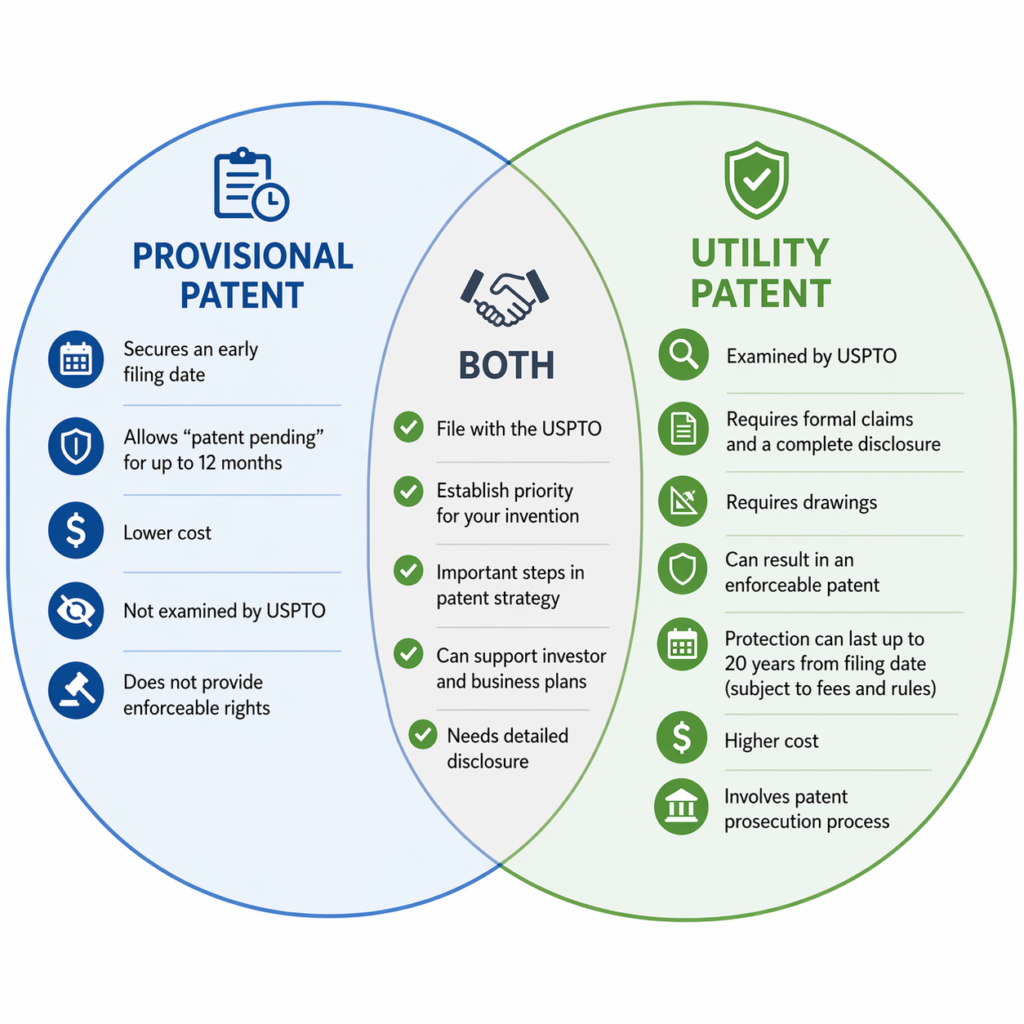
- Cost: A PPA costs $65 to $325 in filing fees, plus drafting fees if professionally drafted, whereas a Non-Provisional application prepared by an intellectual property attorney typically costs between $5,000 and $15,000. See How much does a provisional patent actually cost?
- Speed: A PPA can be filed in as little as 24 hours if the description and drawings are ready, allowing you to move at the speed of business.
- Flexibility: The 12-month “assessment window” provided by a PPA is your most valuable strategic asset. You can use this time to pitch to investors, find a licensee, or test the market to see if the invention is actually commercial before spending thousands on the regular application (Source Context).
Furthermore, the “first-to-file patent law” makes the PPA’s early filing date essential. In the U.S. system, the patent is awarded to the person who is first to file their application, not necessarily the person who was first to think of the idea. A PPA secures that early date against potential competitors.
Step-by-Step Guide: How to Prepare Your PPA
If you decide to move forward with a PPA, you can follow a rapid protocol to secure protection. While speed is an advantage, accuracy is paramount. In the New Railhead Mfg. Co. v. Vermeer Mfg. Co. case, a company lost its patent rights because their PPA failed to adequately describe a specific angled structure of a drill bit, proving that an imprecise description can invalidate your protection later.
Follow these five steps:
- Conduct a US Patent Lookup: Use Google Patents or the USPTO database to find “prior art”—any existing patents or publications that are similar to your idea. Check out our article on DIY Patent Research: How to Run a Prior Art Search Using USPTO and Google Patents.
- Draft the Static Description: Create a list of all the parts (components) of your invention and describe how they physically interact.
- Draft the Operational Description: Explain the step-by-step process of how the invention actually achieves its results.
- Create Informal Drawings: You don’t need a professional artist yet. You can use clear photographs, computer-generated images, or even hand-tracings—utilizing a light box or a piece of glass over a light source—to illustrate the “best mode” of your invention.
- Assemble Filing Forms: You must complete Form AIA/14 (the Application Data Sheet) and Form PTO/SB/16 (the Cover Sheet) for your submission.
The Official USPTO guide to filing a patent application.
Navigating the Hazards: Common Mistakes to Avoid
The patent process is notoriously unforgiving regarding deadlines and the accuracy of information. To maintain your protection and ensure your future “freedom to operate,” avoid these critical errors:
- The 12-Month Cliff: If you do not file your Regular Patent Application (RPA) within exactly 12 months of your PPA filing date, your PPA expires and you lose your earlier filing date forever.
- Public Disclosure: If you sell, offer for sale, or publish your idea more than one year before your filing date, you lose the right to patent it in the U.S. Even worse, for many foreign countries, any public disclosure before filing can destroy your patent rights immediately.
- Adding “New Matter”: You cannot add new technical changes or improvements to an existing PPA. If you modify the invention’s operation, you must file a new PPA for those specific changes. If you miss any important details, you cannot add these to a regular (non-provisional) patent in the future. This is a big reason why it may be worth having a professional draft the PPA.
- The “Post Office Patent” Myth: Some believe that mailing a description to yourself in a sealed envelope provides legal protection. To put it simply: This is not true. Courts and the USPTO do not recognize these as evidence of patent priority.
When to Contact a Patent Agent
While the PPA is designed for a DIY approach, professional help is often a strategic investment even for the PPA. If you do plan to file the PPA yourself, I often recommend that inventors use resources like Patent It Yourself as a companion during the early stages, but there are specific triggers when you should seek the expertise of a registered US patent agent:
- High Value Product: Getting the provisional patent application right on a high value invention, is worth the investment. While a DIY PPA will can save you money up front, it can cost you in patent rights, delays, and money in fixing issues down the road. It’s not worth the risk if your invention can make your investment in drafting fees back.
- Preparing the RPA: Non-Provisional applications have much higher requirements. Navigating these as a first time filer can be tricky, time consuming, and can sometimes cost you patent rights.
- Complex Claims: Drafting the numbered “claims” for a Non-Provisional application requires highly specific legal language that determines the strength of your patent.
- High-Tech Inventions: If your idea involves software patents or complex business methods, professional guidance is essential due to shifting court standards regarding abstract ideas. Additionally, a software patent expert will help point out and identify the aspects of your creation most likely to be granted a patent and how to draft the application to maximize your protection and competitive advantage. If you need help with your software patent, Crafted IP has over 10 years of specialized experience in software, artificial intelligence (AI), graphical user interfaces (GUI), autonomous vehicles, drones, robotics, and navigation systems patents. Contact us if we can help in any way.
- Advanced Searches: Professionals can perform “forward” or “backward” searches using specialized tools like the USPTO patent search systems to find prior art you might have missed. Additionally, a software patent expert will know what keywords are used in patents to describe similar concepts where lay terms may fail.
Have an idea worth protecting?
Protecting your ideas doesn’t have to be overwhelming. We’ll help you understand your options and build a strong patent strategy. Get expert guidance from a former USPTO examiner. With over a decade of experience, our patent agents provide personalized support and guidance every step of the way. From the first consultation to long‑term intellectual property protection, our mission is to simplify the process and safeguard your innovations. Crafted IP specializes in software, artificial intelligence, graphical user interfaces (GUI), autonomous vehicles, drones, robotics, and navigation system patent applications.
Frequently Asked Questions (FAQ)
Can I file a PPA in a foreign language? Yes. Unlike the regular application, a PPA can be filed in any language under 37 CFR 1.52(d).
What is “prior art”? Prior art is anything that has been publicly known, used, or published anywhere in the world before your filing date that is similar to your invention.
Do PPAs apply to design patents? No. PPAs are only available for utility patents—those that cover functional inventions. They cannot be used for design patents, which cover the ornamental appearance of an object.
How do I mark my product once I’ve filed? Once you have your filing acknowledgement from the USPTO, you may mark your product or advertisements with “U.S. Patent Pending”.
Conclusion
The “provisional-first” strategy is the smartest route for many modern inventors. It balances the need for immediate legal protection with the financial reality that most inventions require time to prove their commercial worth.
Your logical first step is always a thorough USPTO patent search to ensure your idea is truly novel and to understand the “prior art” in your field. Once your PPA is on file, leverage that 12-month window to build a prototype, find a licensee, or seek out a business partner. Protecting your great idea doesn’t have to cost a fortune—it just requires a professional strategy.