Estimated reading time: 13 minutes
In today’s hyper-competitive technological ecosystem, the speed of innovation is often surpassed by the speed of imitation. For software developers, the stakes of intellectual property protection reached a zenith on March 16, 2013, with the enactment of the “first-to-file” rule. Under this regime, the United States Patent and Trademark Office (USPTO) no longer prioritizes who conceived an idea first, but rather who is first to the filing desk. Consequently, securing a software patent is not merely a legal checkbox; it is a critical strategic maneuver to establish “patent pending” status before a competitor can block your path. While the legal architecture of patenting is rigorous, it is entirely navigable for the lay developer who adopts a disciplined, structured framework to protect their functional code. Understanding the distinction between a creative script and a protectable functional invention is the first step in this journey. This guide serves as a technical brief to help you bridge the gap between your development workbench and the federal register.
What is Software Patenting?
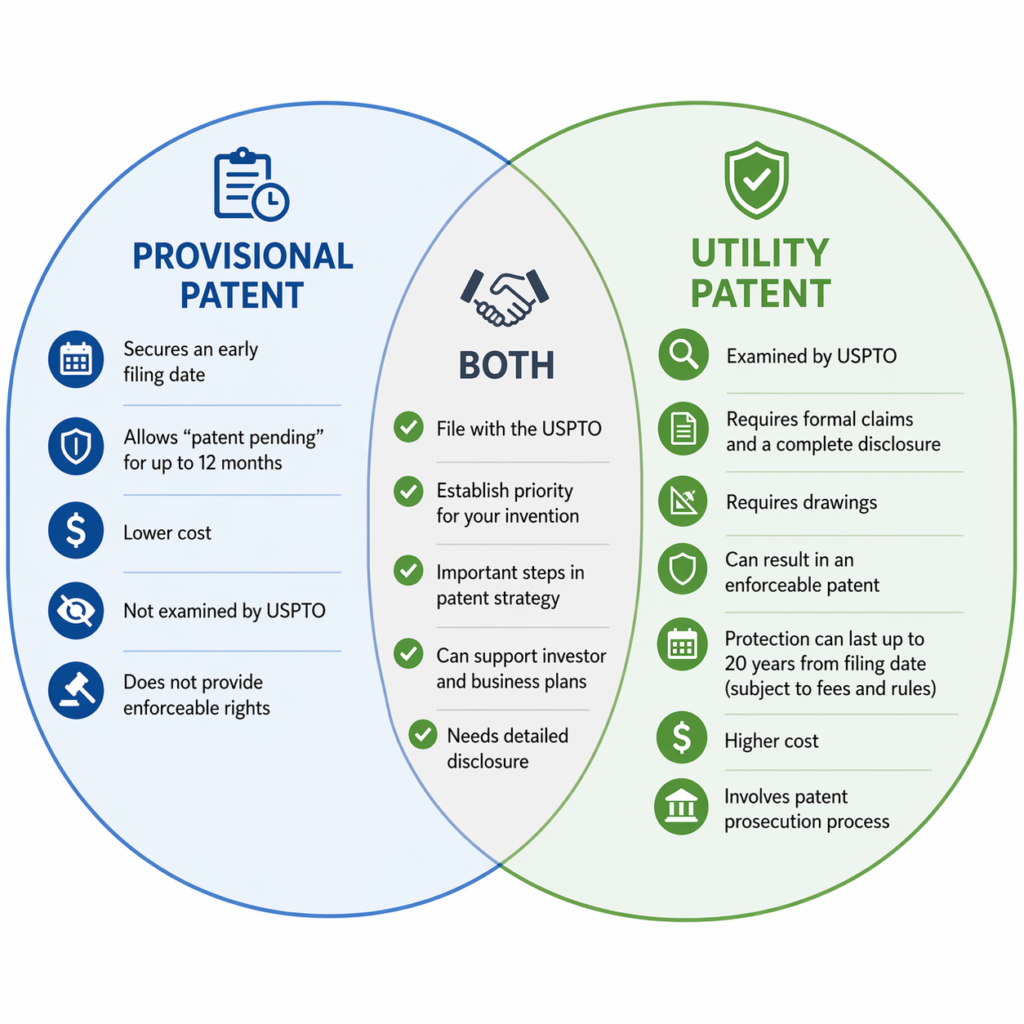
Legally, a patent is best characterized as a “license to sue.” It does not grant you the right to use your invention; instead, it provides the legal authority to exclude others from making, selling, or using your functional innovation for a specific term. In the United States, the legal term for a utility patent is 20 years from the date of filing the Regular Patent Application (RPA). However, due to the 12 to 36 months typically required for USPTO processing, most patent owners enjoy a practical protection window of 17 to 18 years. A computer software patent is a utility patent that protects the functional aspects of your code—specifically what the software does and how it achieves its result—rather than its aesthetic appearance (although graphical user interfaces (GUI) are able to be patented). For developers, the strategic point of entry is the Provisional Patent Application (PPA). Think of the PPA as an inexpensive “placeholder” that locks in your filing date without the immediate requirement of formal “claims” or the 5,000–15,000 investment typically associated with an attorney-led RPA. For a Micro Entity, the filing fee is as low as $65, while a Small Entity pays $130. This filing allows you to claim “patent pending” status for 12 months, providing a low-cost window to validate your software’s commercial potential before committing to a full application. This mechanism is the cornerstone of a lean intellectual property strategy for startups and other software companies. The PPA grants you a year of tactical flexibility to test the market, secure funding, or refine your logic, all while your original filing date remains protected against subsequent filers.
Why Software Protection Matters
The commercial landscape of the tech industry is rife with “idea theft,” where disclosed innovations are intercepted by larger entities with superior resources for rapid commercialization. Establishing “patent pending” status acts as a formidable deterrent; it signals to potential infringers that you have staked a legal claim and that they risk significant litigation damages once the patent issues. Without this shield, your software is vulnerable the moment it is disclosed to a potential partner, investor, or customer. The PPA is the most fiscally responsible tool in your arsenal. It allows you to “test the waters” with the professional cachet of a patent pending notice for a fraction of the cost of a full patent. If the market does not receive the software enthusiastically within those 12 months, you have saved thousands in unnecessary legal fees. If the market embraces it, the PPA has already secured your place in line at the USPTO.
Step-by-Step Guide for Developers
Navigating the patent process is not about mastering legalese; it is about clearing specific legal “hurdles.” To ensure your software is protectable, you must meet the standards of utility, novelty, and non-obviousness. Strategize your procedural timeline using this sequence derived from established USPTO practice:
1. Record and document the invention
What to do
Create a dated, versioned record of the invention using design notes, architecture diagrams, commit history, test logs, demo videos, representative code snippets, configuration files, and benchmark results that show the technical effect. Keep a short narrative explaining the problem, your technical approach, and why it improves on alternatives. If the solution required unintuitive design choices or meaningful refinement, that may be a strong signal of patentable subject matter. A private Git repository with annotated commits, timestamped design documents, and screenshots showing system interfaces at different stages can help preserve a clear development record.
Pitfalls
Avoid vague notes such as “improve matching” unless they include concrete parameters, examples, and implementation details. Also avoid mixing confidential client data into invention records; redact sensitive information or use synthetic examples where possible.
2. Run a prior‑art and patent search
What to do
Search patents, published patent applications, academic papers, technical blogs, and other public materials for similar algorithms, architectures, or system-level approaches. Identify the closest references and note which features are already disclosed. A useful starting point is USPTO Patent Public Search, Google Patents, and WIPO PATENTSCOPE for patent literature, followed by academic resources such as Google Scholar and arXiv for non-patent prior art. Search by both function and structure, combining technical keywords, implementation details, and classification codes when available.
Pitfalls
Do not stop at keyword matches. Read the claims and specifications carefully to understand the actual scope of each reference, and do not ignore non-patent literature because it can still destroy novelty. DIY searching can be helpful, but patent documents often use highly specific terminology that varies by application, so a trained searcher such as Crafted IP can help identify important prior art that might otherwise be missed.
See my guide on DIY Patent Research: How to Run a Prior Art Search Using USPTO and Google Patents.
3. Decide provisional versus non‑provisional
What to do
Choose a Provisional Patent Application (PPA), also called a provisional patent, if you need 12 months to validate, prototype, refine the invention, or raise funds. Choose a Regular Patent Application (RPA), also called a non-provisional utility patent, when you are ready to pursue examination and have a mature disclosure. A PPA should still include a complete technical disclosure rather than a rough outline. During the PPA year, plan the RPA content by expanding examples, and developing a claim strategy. Track the 12-month deadline carefully because missing it can forfeit priority.
Pitfalls
Avoid filing a thin PPA that lacks enablement; a weak provisional application may provide little real priority protection. Also remember that a PPA is not a substitute for a well-drafted RPA. To obtain enforceable patent rights, you must still file a RPA and have claims granted by the patent office.
See our guide on Provisional vs. Non-Provisional: How a USPTO Patent Search Protects Your Invention.
The Official USPTO guide to filing a patent application.
4. Draft a technical disclosure
What to do
Prepare a written specification that explains the architecture, algorithms, data structures, inputs and outputs, parameter ranges, failure modes, and edge-case handling. Include pseudo-code or concrete examples where useful. A strong disclosure typically covers the system overview, data flow, algorithmic steps, performance characteristics, and example runs. At least one fully worked example with real or synthetic data can show inputs, intermediate states, and outputs. Include alternative embodiments and variations to broaden coverage, along with generic low-level computer architecture to support system or apparatus claims. For software, draft with the “abstract idea” issue in mind: the application should document a specific technological improvement or unique functional solution, not merely computerize a conventional process.
Pitfalls
Avoid high-level marketing language that lacks technical depth, and do not omit edge cases or parameter limits that an examiner may expect for enablement.
5. Draft figures and flow diagrams
What to do
Create diagrams that explain system components, data flows, sequence interactions, and algorithmic branches. Annotated screenshots can be useful as supplements, but they should not replace technical drawings. Include the architecture diagram, component interaction flow, sequence diagram for critical processes, and flowcharts for important algorithms where needed. Label elements with reference numbers and use those numbers consistently in the specification so the text and figures reinforce each other.
Pitfalls
Do not rely solely on screenshots or user interface mockups because they usually do not explain backend processing. Unlabeled or ambiguous diagrams can also weaken the disclosure if they are not clearly tied to the written description.
6. Prepare a claims strategy at a high level
What to do
Map out claim families that connect the invention’s features to technical improvements, such as reduced latency, memory savings, novel data indexing, improved resource allocation, or more reliable processing. Identify independent claim concepts for a system, method, and computer-readable medium, then support them with dependent claims that add concrete limitations. For software, claims should reference tangible components or specific processing steps rather than only business goals or user-facing outcomes. Plan fallback positions in advance so narrower dependent claims can help survive eligibility or prior-art rejections.
Pitfalls
Avoid drafting claims as mere UI flows or business rules without a technical anchor. Claims that are too broad can invite early rejection or make it easier for competitors to design around the invention.
7. File PPA or RPA
What to do
File electronically through the USPTO portal or the appropriate jurisdictional system. For a PPA, make sure the disclosure is enabling and includes figures and examples. For an RPA, include formal claims, an abstract, complete drawings, and any required forms such as an Application Data Sheet. Consider using a patent agent to avoid procedural mistakes and to improve the quality of the filing language. Keep submission receipts, confirmation numbers, and copies of all filed documents.
Pitfalls
Do not file an incomplete PPA merely to “reserve a date” if the disclosure is not enabling. Be careful with paper filing because surcharges and processing delays may apply. Most importantly, do not miss the 12-month deadline to file a RPA because a PPA alone does not patent the idea.

8. Iterate, and test
What to do
During the PPA year and after filing, continue tracking improvements so you can decide whether to file a later PPA or RPA directed to the new material. New features generally cannot be added to a RPA that claims priority to an earlier PPA, but they may be protected in a new application with a later filing date. Use this period to assess whether the software is generating revenue, whether competitors are entering the market, and whether a full RPA would provide a meaningful competitive advantage.
Pitfalls
Do not forget to protect upgrades and improvements to the first invention. Also avoid adding new matter to an application that depends on an earlier priority date because doing so can undermine the priority claim for that new material.
9. Engage a specialist before filing the RPA
What to do
Contact a registered patent agent or software-patent attorney before filing the RPA so they can draft claims, evaluate eligibility under Section 101, and prepare a prosecution strategy. Provide the specialist with the full disclosure, diagrams, test evidence, and prior-art search results. It is also useful to request a patentability opinion and a proposed claim set with fallback claims and amendment strategies. Professional drafting requires budget, but good claim drafting can reduce long-term prosecution costs and improve the value of the resulting application.
Pitfalls
Avoid waiting until after an adverse office action to hire counsel because early involvement can save time, reduce costs, and prevent problems caused by poor initial drafting. Be cautious about hiring non-specialists who lack experience with software eligibility issues; a software-focused patent agent, such as Crafted IP, may be better positioned to handle Section 101 and technical disclosure issues. Also remember that missing the 12-month RPA deadline can prevent the PPA from serving its intended purpose.
Have an idea worth protecting?
Protecting your ideas doesn’t have to be overwhelming. We’ll help you understand your options and build a strong patent strategy. Get expert guidance from a former USPTO examiner. With over a decade of experience, our patent agents provide personalized support and guidance every step of the way. From the first consultation to long‑term intellectual property protection, our mission is to simplify the process and safeguard your innovations. Crafted IP specializes in software, artificial intelligence, graphical user interfaces (GUI), autonomous vehicles, drones, robotics, and navigation system patent applications.
10. Plan international protection if needed
What to do
If foreign protection may be important, decide early whether to pursue national filings, the Paris Convention route, or a PCT application within 12 months of the earliest filing. If global protection is desired, coordinate with counsel experienced in the target jurisdictions so the claims and disclosure can be adapted to local patentability standards, including technical-effect requirements that may apply to software inventions outside the United States.
Pitfalls
Do not miss the 12-month deadline if foreign priority matters. Also avoid assuming that U.S. claim language will be accepted unchanged abroad because many jurisdictions require different framing for software inventions.
When to Contact a Software Patent Agent or Patent Lawyer
While a Provisional Patent Application (PPA) can serve as a low‑cost, do‑it‑yourself entry point, software inventions introduce unique challenges that make professional guidance almost essential once you move toward a Regular Patent Application (RPA). Drafting claims for software requires balancing breadth and specificity: they must be broad enough to cover variations of your algorithm or architecture, yet precise enough to withstand scrutiny under Section 101 (patent‑eligible subject matter) and Section 112 (enablement and written description).
Software patents are particularly vulnerable to rejection as “abstract ideas” if they are framed only in terms of business rules or user interface flows. A skilled patent agent or lawyer knows how to anchor claims in technical improvements—for example, efficiency gains in data processing, novel memory management techniques, or unique algorithmic structures—rather than high‑level functional descriptions. They can also help you include pseudo‑code, system diagrams, and edge‑case handling that demonstrate enablement and reduce the risk of invalidation.
If you anticipate a global market, professional counsel becomes even more critical. International filings under the Paris Convention or the Patent Cooperation Treaty (PCT) impose strict 12‑month deadlines and require adapting your disclosure to jurisdictions with different standards for software patentability. For instance, Europe demands a “technical effect,” while other regions may have narrower or broader interpretations of software eligibility. An experienced specialist ensures your U.S. filing is drafted to serve as a valid springboard for worldwide protection, while avoiding pitfalls that could limit enforceability abroad.
In short, software patents are among the most complex areas of intellectual property. Engaging a registered patent agent or attorney early in the process can mean the difference between a robust, enforceable asset and an application that fails at the first hurdle.
Conclusion
The journey to securing a software patent is a transition from the abstract logic of code to the concrete protection of a functional asset. By leveraging the Provisional Patent Application, you can secure a vital “first-to-file” date and “patent pending” status without immediate financial strain. This strategic window allows you to refine your code and validate its commercial worth. While the filing process can technically be completed in 24 hours, its ultimate strength lies in your diligence and accuracy. Protection is the ultimate exercise of creative agency; it ensures your innovation remains yours.