Introduction
Estimated reading time: 9 minutes
Inventors often ask a very reasonable question: what is the difference between a provisional patent application and a utility patent application? The wording can be confusing because people often say “provisional patent,” even though the provisional filing does not actually become a patent by itself. It is more like holding your place in line while you prepare the full application. Helpful, yes. Magical, no.
A provisional patent application can be a smart first step when an invention is still being refined, when funding conversations are starting, or when an inventor needs an early filing date before making the idea public. A utility patent application also called a non-provisional utility patent application, by contrast, is the formal application that the US Patent and Trademark Office, or USPTO, examines. If the USPTO eventually allows the claims and the patent issues, the resulting utility patent can provide enforceable rights. This article explains the difference in plain language so you can choose a filing strategy that fits your invention, your budget, and your timeline.
What Is a Provisional Patent?
A provisional patent application, often shortened to PPA, is a temporary filing that can secure an early filing date for your invention. That filing date matters because the United States generally follows a first-to-file system. In practical terms, getting an early date on file can help show that your invention was disclosed to the USPTO before later filings by others.
A provisional application is not examined by the USPTO and does not give you the right to stop someone from copying your invention. It does, however, allow you to use “patent pending” for up to 12 months while you prepare and file a related non-provisional utility patent application. Think of it as a reservation for your invention. You still need to show up for dinner, but at least the table has your name on it.
What a provisional application can and cannot do
- Its value depends heavily on the quality and detail of the disclosure you file.
- A provisional application can secure a filing date, support “patent pending” status, and give you up to 12 months to prepare the full utility filing.
- It does not get examined, does not issue as a patent, and does not provide enforceable rights by itself.
What Is a Utility Patent application?
A utility patent application, also called a non-provisional utility patent application, is the formal filing used to seek patent protection for how an invention works, operates, or is used. Utility patents can cover processes, machines, manufactured products, compositions of matter, and useful improvements to those things. In everyday language, a utility patent protects function. If the invention is a new drone navigation system, the utility application may focus on how the navigation logic, sensors, control rules, or data processing work together.
That is different from a design patent, which protects the ornamental appearance of a product rather than how it functions. A design patent might protect the distinctive shape or surface appearance of the drone, while a utility patent may protect the technical system that helps the drone navigate. Both can be valuable, but they protect different parts of the innovation.
Unlike a provisional application, a non-provisional utility patent application is examined by the USPTO. The examiner reviews the claims, which are the numbered sentences that define the legal boundaries of the invention. If the claims are allowed and the patent issues, the inventor may receive enforceable rights for up to 20 years from the filing date of the non-provisional application, subject to maintenance fees and other rules.
Comparing Provisional and Non-Provisional Utility Patents
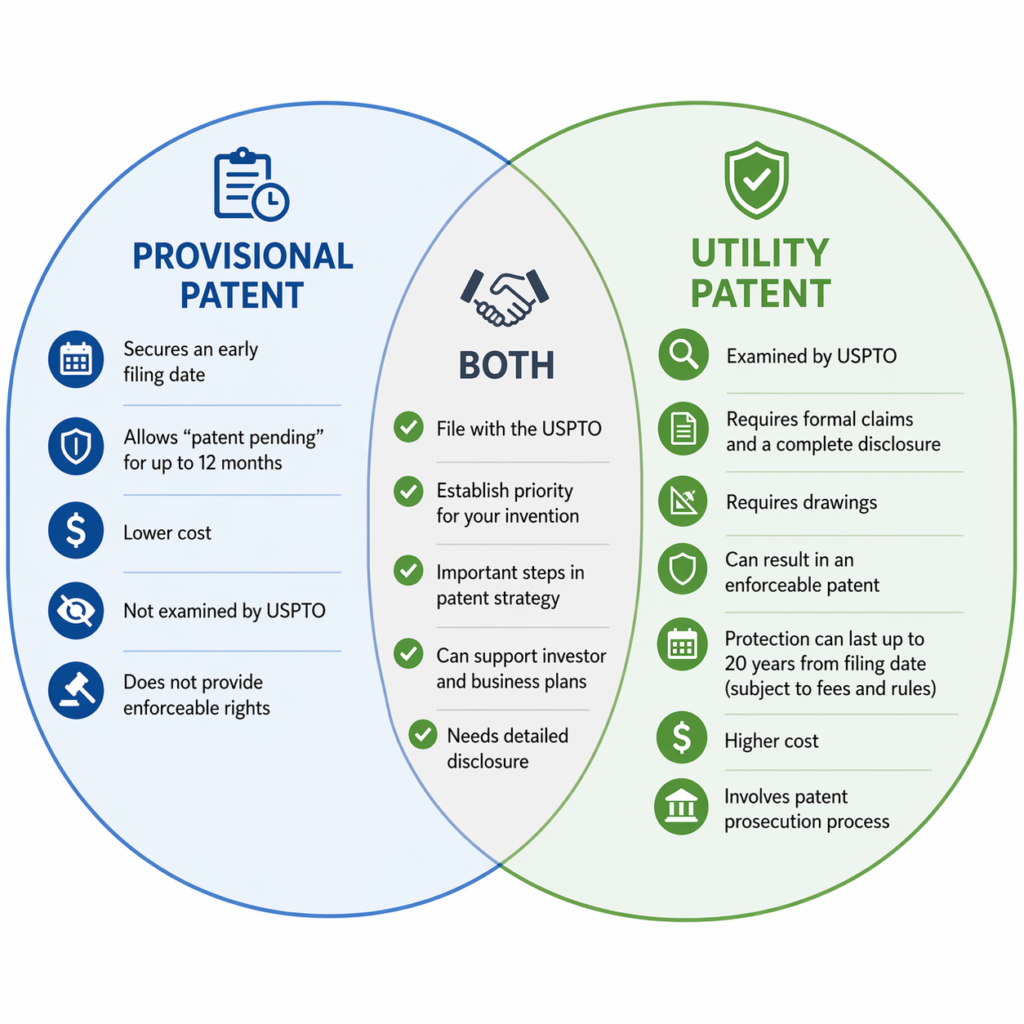
The biggest difference is purpose. A provisional application is mainly about timing. It can preserve an early filing date and give you a 12-month window to refine the invention, test the market, talk with investors, or prepare a stronger full application. A utility patent application is about examination and enforceable protection. It is the filing that the USPTO reviews, and it is the filing that can eventually mature into an issued patent.
Cost is another major difference. A provisional application is usually less expensive because it does not require formal claims in the same way a non-provisional application does, and it is not examined. Professional fees for a well-prepared provisional commonly fall below the cost of a full utility application. A non-provisional utility patent application usually costs more because it requires a more complete technical disclosure, careful claim drafting, USPTO forms, and later examination work.
As a rough planning range, a patent agent may charge around $1,500 to $3,500 for many provisional applications, while a patent attorney may charge around $2,500 to $5,000 depending on complexity and strategy. A non-provisional utility patent application often costs more, commonly in the range of $4,500 to $15,000 or higher for complex technology. These ranges are not universal, but they help explain why many inventors use a provisional filing as a first step rather than jumping directly into the full utility application.
See our guide on How much does a provisional patent cost in total?
Protection is where the distinction becomes most important. A provisional application can help establish priority and permit “patent pending” language, but it does not let you sue for infringement. Only an issued patent provides enforceable rights. That means a provisional is not the finish line. It is the opening move.
See our guide on Provisional vs. Non-Provisional: How a USPTO Patent Search Protects Your Invention.
Why Use a Provisional Patent?
Inventors often use provisional applications because inventions rarely arrive fully dressed and ready for court. A product may still need testing. Software may still need technical refinement. A prototype may work in one setting but need changes before manufacturing. A provisional filing can create breathing room while still placing a stake in the ground.
That breathing room can be especially useful before investor meetings, product launches, pitch competitions, crowdfunding campaigns, or public demos. Once an invention becomes public, timing can become more complicated. Filing first gives you a cleaner starting point and reduces the risk that a public disclosure creates avoidable problems.
Why File a Non-Provisional Utility Patent?
A non-provisional utility patent application is necessary if you want the USPTO to examine the invention and potentially grant a patent. This is where claim strategy becomes central. Claims define what the patent would actually protect, so they need to be written carefully and supported by the technical description in the application.
The utility application also starts the process known as patent prosecution. Despite the dramatic name, patent prosecution is not a courtroom battle. It is the back-and-forth process between the applicant and the USPTO examiner. The examiner may reject claims based on prior art, which means earlier patents, publications, products, or public disclosures. The applicant then responds, argues, amends the claims, or explains why the invention is patentable.
Steps to Transition from Provisional to Utility
The transition from provisional to utility should be planned early. After filing a provisional application, you generally have 12 months to file a related non-provisional utility application that claims priority to the provisional. Claiming priority means asking the USPTO to treat the later utility application as having the benefit of the earlier provisional filing date for subject matter that was properly described in the provisional.
During that 12-month period, you should refine the invention, gather technical details, update drawings, consider a prior art search, and work with a US patent agent or intellectual property attorney to prepare the non-provisional filing.
Searching for a patent agent near me? Here’s what matters more.
The important part is not simply filing something before the deadline. The later utility application needs to be supported by the provisional. If the provisional was too thin, vague, or incomplete, the priority claim may be weaker than expected. A provisional should not be treated like a napkin sketch with a filing receipt attached. Napkins have their place, but usually not as the backbone of a patent strategy.
- File a provisional application to secure your date.
- Develop your invention further during the 12‑month window.
- Work with a US patent agent or intellectual property attorney to draft a utility application. Searching for a patent agent near me? Here’s what matters more.
- File the utility patent application before the provisional expires.
- Respond to USPTO examination as part of prosecuting a patent.
Have an idea worth protecting?
Protecting your ideas doesn’t have to be overwhelming. We’ll help you understand your options and build a strong patent strategy. Get expert guidance from a former USPTO examiner. With over a decade of experience, our patent agents provide personalized support and guidance every step of the way. From the first consultation to long‑term intellectual property protection, our mission is to simplify the process and safeguard your innovations. Crafted IP specializes in software, artificial intelligence, graphical user interfaces (GUI), autonomous vehicles, drones, robotics, and navigation system patent applications.
Conclusion
So, what’s the difference between a provisional patent and a utility patent? A provisional secures your filing date and gives you “patent pending” status, but it does not grant enforceable rights. A utility patent, once approved, provides full legal protection for up to 20 years. Working with a US patent agent or intellectual property attorney ensures your filings meet the requirements of the law of patent and provide real intellectual property protection.
Frequently Asked Questions
Can I enforce a provisional patent?
No. A provisional application does not provide enforceable patent rights by itself. You cannot sue someone for infringement based only on a provisional filing. Enforceable rights come from an issued patent, which usually requires filing and prosecuting a non-provisional utility application.
Is a provisional patent cheaper?
Usually, yes. A provisional application is often cheaper than a non-provisional utility application because it is not examined and does not require the same formal claim structure. Still, cheap should not mean thin. A low-cost filing that fails to describe the invention well may not provide much value later. See our guide on How much does a provisional patent cost in total?
Do provisional patents protect software inventions?
Yes, a provisional application can be used for software inventions, but software requires careful drafting. The application should explain the technical problem, the technical solution, and how the software actually operates. For software, artificial intelligence, fintech, and similar technologies, a software-focused patent agent or attorney can help frame the invention as more than a high-level business idea performed on a generic computer.